Stephen welcomes recent announcements from the Chancellor, in particular her pledge on fiscal devolution.
It's 'game on' for fiscal devolution - a blog from Core Cities UK Director Stephen Jones
Share
19 March 2026

Last month, Core Cities UK Leaders, Chief Executives and Directors hosted colleagues from regional and central government, public finance institutions and partners in the private sector for our Investment Summit in Leeds.
At the event, we explored the need for blended finance investment funds that can leverage the private capital that we need to densify our city centres, bringing housing and commercial development forward that can support growth in knowledge-intensive sectors and realise agglomeration benefits.
You can find a summary of our discussions here.
The Investment Summit was one of the recommendations in 2023 of the Urban Futures Commission that Core Cities UK undertook in partnership with the RSA and Lloyds Banking Group. In that commission, we identified the £100bn growth dividend across our cities from kickstarting large scale investment.
To realise those benefits, we called for the establishment of “publicly capitalised investment funds” for our major cities and a need to “enhance fiscal devolution, through a target for HM Treasury to bring the shares of taxes controlled locally to the OECD average”.
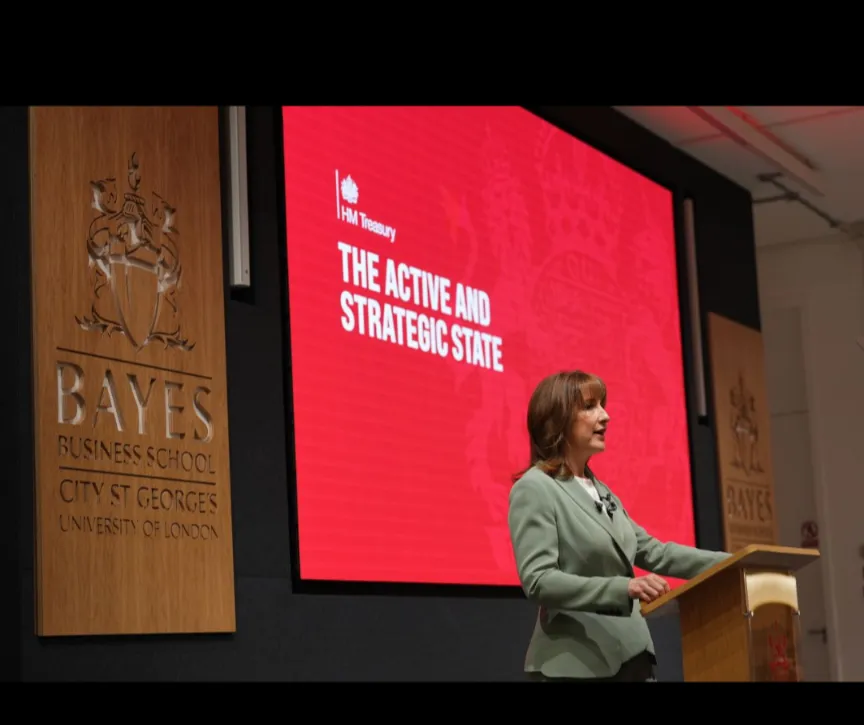
It was great to see the Chancellor responding so positively to our recommendations in her recent Mais. Hearing statements on closer trading relationships to Europe and seeking to capitalise on the research and innovation strengths across the UK to harness the potential of AI and technology will be welcomed by our cities. But it was two announcements yesterday that were really exciting for Core Cities.
Firstly, the announcement of £2.3bn for City Investment Funds, to provide cash and tools to “bulldoze through roadblocks holding up big city-centre projects and large scale regeneration schemes - from housing and offices to transport-linked developments that will create jobs and unlock growth in the heart of our cities.”
This is what we have been calling for and is a huge opportunity to drive growth and investment and pace and scale.
Putting a proposal to the Treasury is a lot like asking your chatbot of choice to produce a birthday image for one of your mates.
It goes blurred for a bit after the prompt then something pops up that is just what you wanted. You’re delighted and get ready to send.
However, on closer inspection, you notice that one of the people in the image has three arms. It isn’t perfect but you’ve ran out of images for the day, so you see the positives and send it on anyway, noting to yourself to be better at prompting next time. The third arm in this case, is the rationing of these funds to cities based on administrative reasoning rather than economic potential. As our evidence shows, the viability challenges that these funds can bridge exist as much in Bristol, Cardiff and Glasgow as they do in Liverpool, Leeds or Newcastle.
Nonetheless, it is a huge step forward and it is incumbent on the half of our member cities that will receive these new funds to prove that they work, and prove that quickly, so it becomes a given that we roll this approach out to all major cities across all parts of the UK.
Secondly, was the announcement that genuinely surprised me on fiscal devolution.
I noted above how we had called for progress on this in the Urban Futures Commission in 2023 but let me lift the lid a bit on the conversations we had prior to including this recommendation.
Slightly exasperated, I sent the following email to our Co-Chairs of the Commission, Andy Haldane and Lord Rees of Easton.
• The evidence on the centralisation of revenue raising powers in the UK is stark and persistent. Other countries have resolved the trade-off between allowing local areas more control over tax revenues and geographical disparities of revenues between wealthy and poorer parts of their countries. So why haven't we made any real progress on this issue in the UK.
• It is not for the want of the intellectual argument:
o It is 19 years since Dame Kate Barker produced her first report on housing that advocated the introduction of a tax on land value;
o It is 17 years since Sir Rod Eddington set out the need to reform road and fuel taxation and replaced with a localised system of road pricing;
o It is 16 years since Sir Michael Lyons advocated reforms to Council Tax, the devolution of a proportion of income tax to Local Government and the introduction of a local tourist tax;
o It is 13 years since Sir James Mirrlees produced his magnus opus on the UK tax system that advocated for a reform of property taxes towards a land value tax, and for a more effective system of taxing environmental degradation and carbon.
o It is ten years since Professor Tony Travers published his London Finance Commission advocating the devolution of property taxes and reform of the finance settlement for London.
o ...The list goes on...
• All of these were serious pieces of work. Designed thoughtfully by experts. learning from experience around the world, and reflecting on how they could be implemented, recognising the costs and benefits of making the change.
• Yet, despite this, we remain in largely the same position on the devolution of taxation to local government since the turn of the century, though some progress has been made in relation to the Devolved National Governments.
• As we look to the next General Election and beyond, the position facing some of our key elements of the UK tax base is fragile. Council Tax continues based on house price valuations that are now 30+ years out of date. Business Rates as a tax on physical premise is becoming increasingly distorting in a world of hybrid and online business activity. Road tax and fuel duty will need to adjust to the shift to electric vehicles. They are all ripe for reform.
• There is also a growing case for the use of tax to tackle externalities and social ills in our towns and cities. Local Government is leading the charge on implementation of clean air zones. Cities are chomping at the bit to adopt the use of tourism taxes to ensure the impact of visitors on local services are accounted for. Innovative ideas are coming forward for improving public health through taxation, such as takeaway taxes.
• So, we should probably make the case in the Commission. But the risk is we are met with the dead bat response that “taxation is a matter for the Chancellor” and our report sits alongside these luminaries in being unheeded.
So to be in a position a few years later where we are moving towards legislation on the introduction of a visitor levy and to hear the Chancellor of the Exchequer say “that I have asked my officials to work with mayors and businesses, to develop a roadmap for future fiscal devolution, to be published at this year’s Budget.” is a major moment and one that really excites us across Core Cities. Game on…
The Chancellor's announcement is a major moment and one that really excites us across Core Cities. Game on…